A HISTORY OF HONG KONG TAILORS
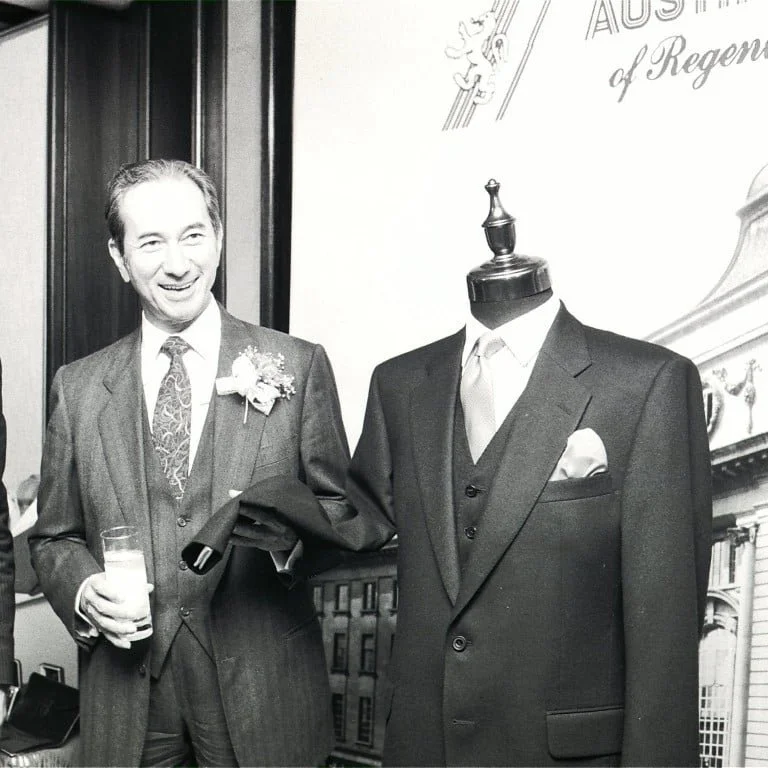
Stanley Ho Hung-sun, Hong Kong & Macau tycoon
Tailors: From Shanghai Roots to Global Bespoke Legacy
Hong Kong's tailoring industry stands as a testament to the city's unique fusion of Eastern craftsmanship and Western sophistication. Emerging from the shadows of colonial trade, wartime migrations, and post-war economic booms, it transformed a modest craft into a global symbol of bespoke elegance. At its peak in the 1960s, Hong Kong boasted over 15,000 tailors, outshining London's Savile Row as the world's sartorial epicenter. Today, amid fast fashion's dominance and generational shifts, it endures as a beacon of artisanal precision—affordable, rapid, and impeccably fitted. This history weaves together migration stories, cultural exchanges, and economic pivots, drawing on archival accounts, industry records, and contemporary insights to offer the most detailed chronicle available.
Origins: Shanghai's "Red Gang" and Colonial Foundations (Late 19th to Early 20th Century)
The seeds of Hong Kong's tailoring prowess were sown in Shanghai during the late 19th century, amid the treaty ports' cosmopolitan fervor. Following the Opium Wars (1839–1860), British colonial expansion opened China to Western trade, creating demand for European-style garments among expatriates, missionaries, and affluent locals. Shanghai's foreign concessions—British, French, and American—became hubs of luxury, where tailors catered to a diverse elite.
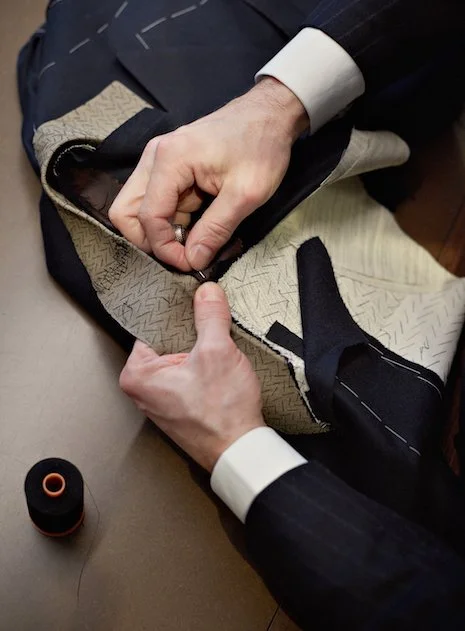
Enter the "Red Gang" (or "Hong Bang"), a guild of skilled artisans primarily from Ningbo, a coastal city south of Shanghai. These migrant tailors, often from impoverished backgrounds, apprenticed under British firms like those from Savile Row, learning techniques such as structured shoulders, curved chests, and hand-stitched lapels. The "red" moniker likely derives from the ruddy complexions of their Caucasian clients or Ningbo's regional associations. By the 1920s, they had formalized training at institutions like the Shanghai Cutting and Tailoring College (founded 1941), blending British draping with intricate Chinese embroidery for durability in humid climates.
Hong Kong, ceded to Britain in 1842, inherited this legacy through its role as a free port. Early colonial tailors served British officials and merchants, establishing shops in Central and Tsim Sha Tsui. Local Cantonese tailors, drawing from Guangzhou traditions, focused on simpler, straight-cut garments for Chinese clients, creating a dual ecosystem: Western bespoke for expats and practical attire for locals. By the 1920s, around 600 tailors operated in Hong Kong, laying the groundwork for explosive growth.
Wartime Disruptions and Post-War Migration Boom (1930s–1950s)
The 1930s brought turmoil: Japan's invasion of Shanghai in 1937 shattered its expatriate economy, prompting early migrations to stable British Hong Kong. Tailors like those from Loa Hai Shing (est. Shanghai 1913) relocated workshops, serving fleeing Europeans. The Japanese occupation of Hong Kong (1941–1945)—a brutal era of martial law, rationing, and forced labor—stifled the industry. Factories were seized for military uniforms, and civilian tailoring dwindled to subsistence levels, with many artisans surviving by mending or bartering.
Liberation in 1945 unleashed a renaissance. The Chinese Civil War (1946–1949) and Communist Revolution drove waves of Shanghai refugees—entrepreneurs, intellectuals, and skilled laborers—to Hong Kong. Among them were hundreds of "Red Gang" tailors, who brought capital, techniques, and clientele. North Point became "Little Shanghai," buzzing with workshops. This influx, combined with returning British expats, fueled a boom: by the early 1950s, Hong Kong's garment sector employed thousands, exporting suits worldwide.
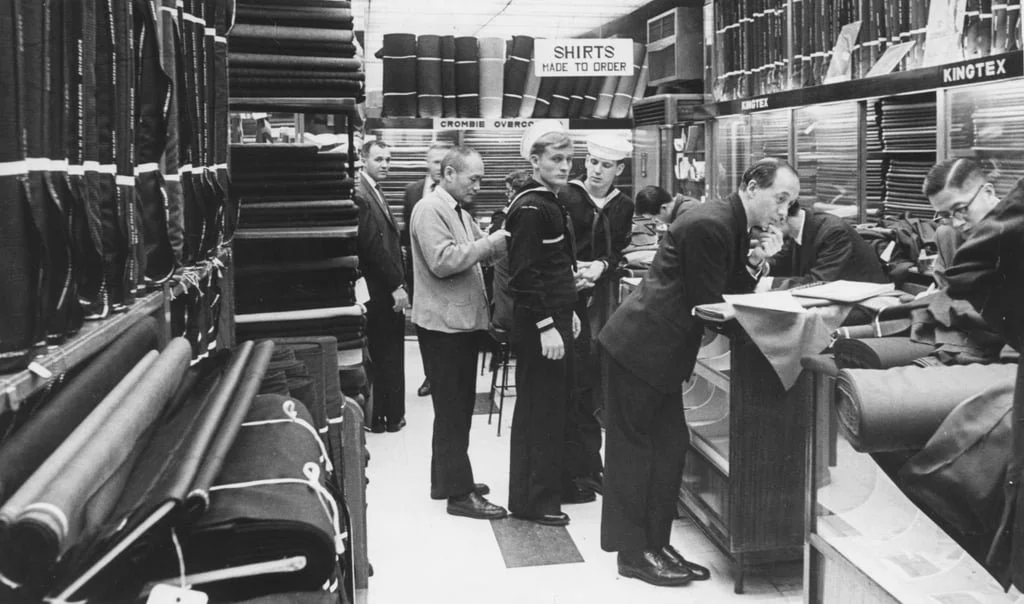
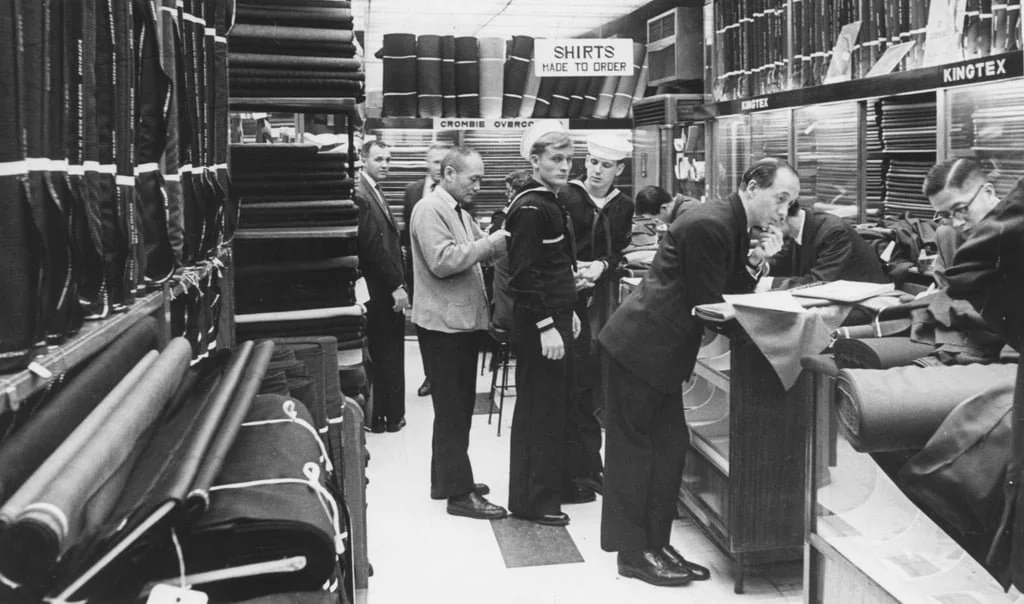
The Korean War (1950–1953) supercharged demand, as U.S. troops on R&R sought affordable bespoke. Tailors like Loa Hai Shing secured Navy contracts for durable uniforms, specifying thread counts and stiffening for protection. Cantonese firms adapted, pioneering mail-order suits via pioneers like Hari Harilela (est. 1940s), who later diversified into real estate.
The Golden Age: Savile Row's Rival and Celebrity Cachet (1960s–1980s)
By 1966, the South China Morning Post proclaimed Hong Kong the "sartorial capital," eclipsing Savile Row with 15,000 tailors producing suits in days, not weeks. Tsim Sha Tsui's Nathan Road and Kimberley Street—dubbed the "Golden Mile"—teemed with shops; Mirador Mansion alone housed 500 tailors. The Vietnam War (1955–1975) amplified this, with U.S. servicemen commissioning thousands of garments, from wool suits to sharkskin jackets.
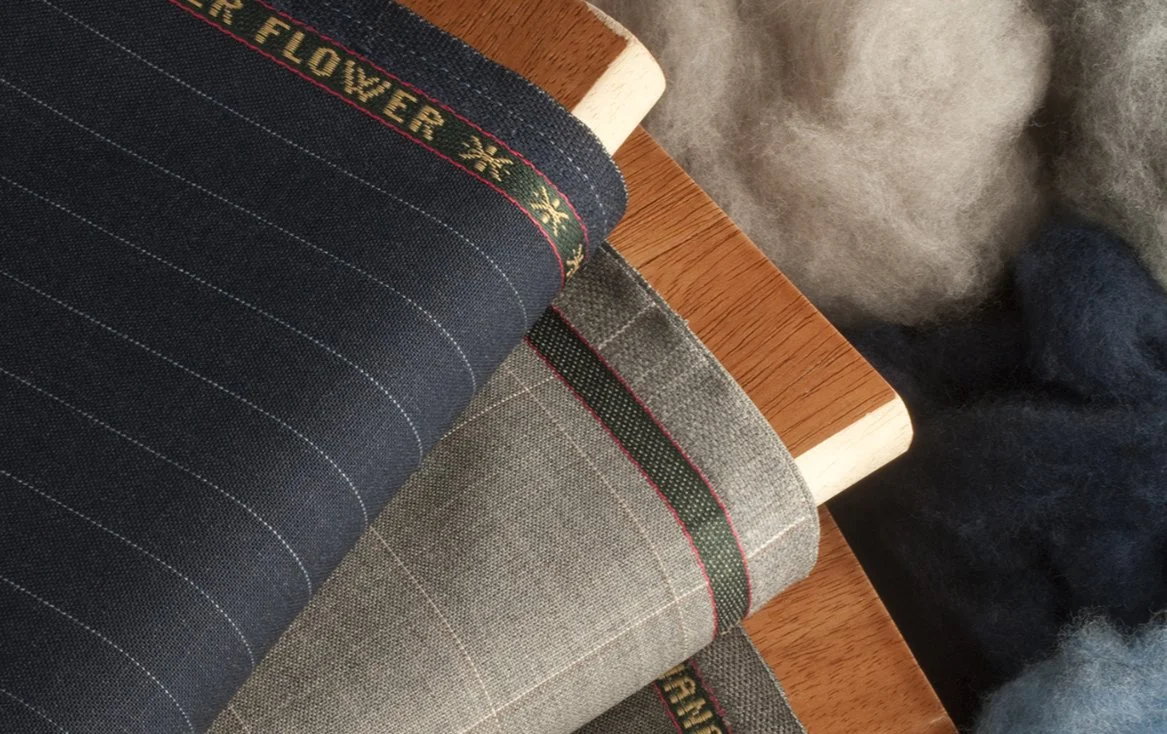
Hong Kong's edge? Speed (2–3 fittings over days), affordability (Super 100 Italian wools at half Savile Row prices), and fusion styles: structured British shoulders with lightweight linings for tropical heat. The "Big Four" Cantonese tailors—A-Man Hing Cheong (est. 1948), Henry Coat (est. 1950s), Tak Cheong (est. 1940s), and Yee On Tai (est. 1937)—dominated locals, while Shanghainese houses like W.W. Chan (est. 1952) and Ascot Chang (est. 1953) excelled in precision.
Celebrities flocked: David Bowie, Mick Jagger, and George Harrison donned bespoke from Jimmy Chen (est. 1948). Indian-Sindhi firms like Harilela's (est. 1940s) and Sam's Tailor (est. 1957) catered to British military, with Sam's neon-lit shop becoming iconic for 48-hour turnarounds. British holdovers like Mackintosh's (est. 1913) persisted until the 1970s, blending colonial elegance with local flair.
Contemporary Landscape and Adaptation: Globalization's Double Edge (1990s–2010s)
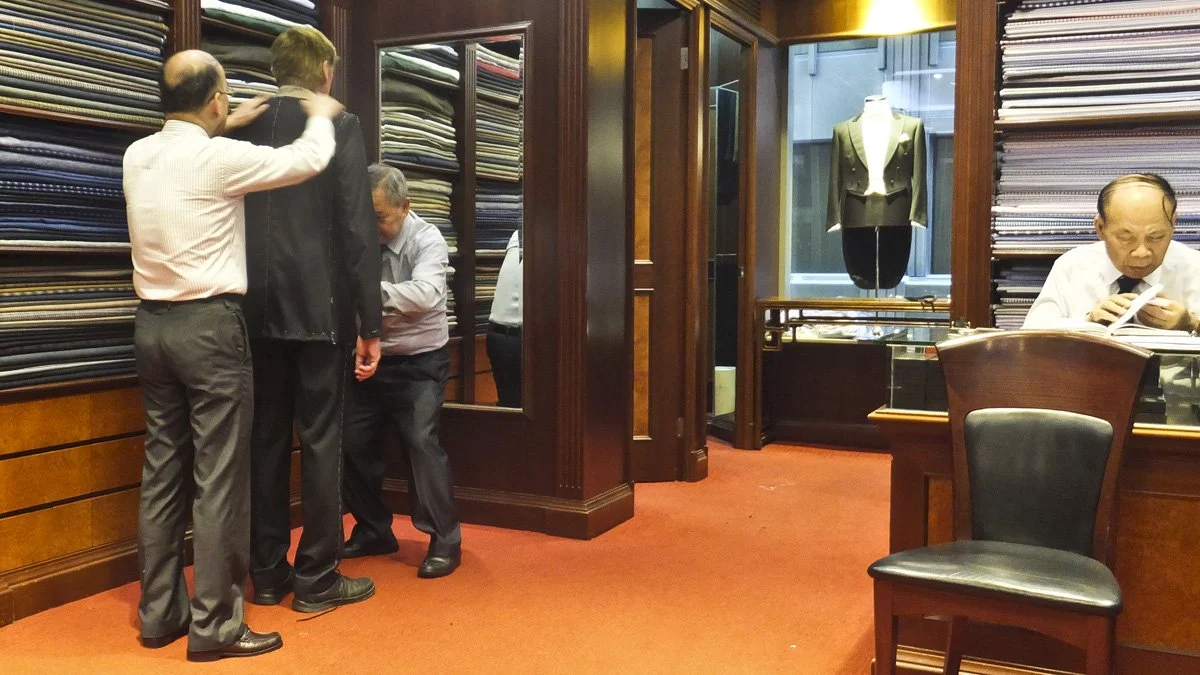
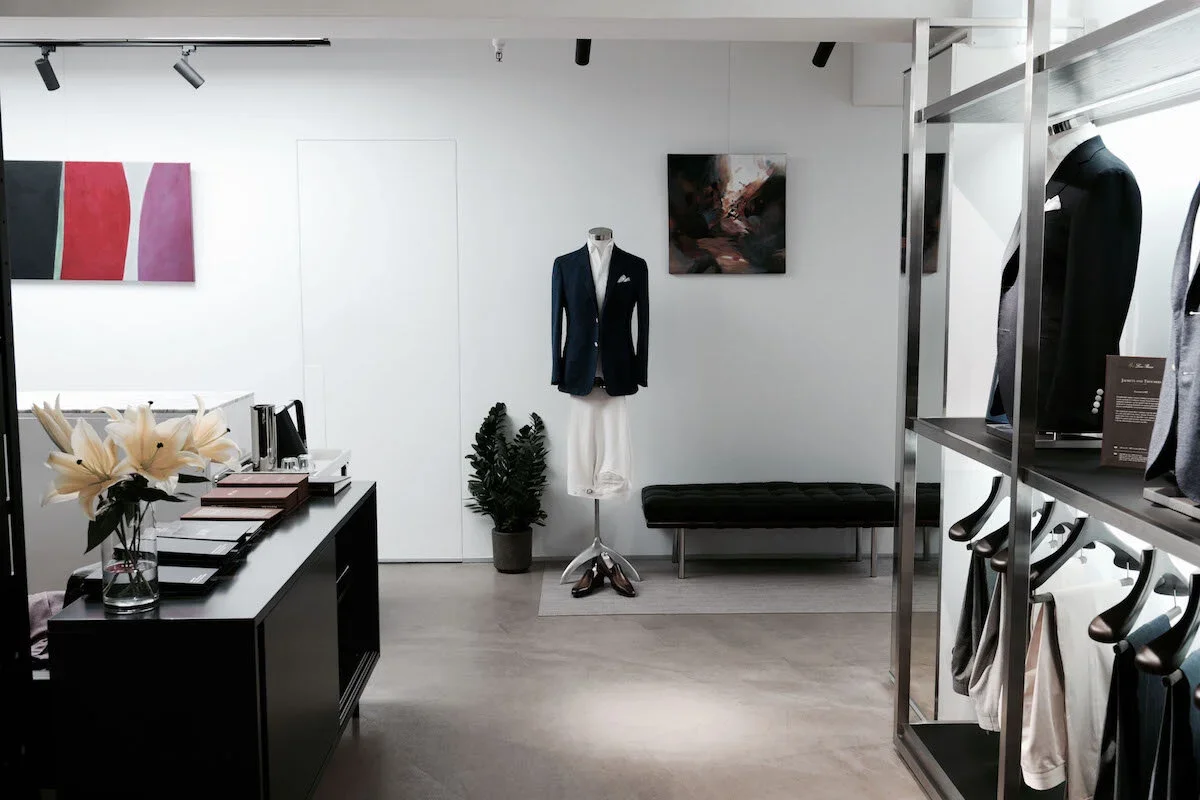
Far from fading into nostalgia, Hong Kong’s tailoring scene is experiencing a spirited renaissance. While it is true that the city still has hundreds of shops bearing the word “tailor” on Nathan Road and in the arcade buildings, quality varies enormously. Many are volume-driven operations focused on tourist souvenirs or fast alterations, but a select handful continue to uphold (and in some cases surpass) the legendary standards of the Golden Age. These are the houses that discerning clients—local tycoons, international executives, and style connoisseurs—still swear by.At the forefront of this new wave are brands that are actively reinvigorating Asian tailoring with fresh energy, global perspective, and uncompromising craft
For anyone who believes that the finest clothing is still made by human hands, guided by centuries of accumulated wisdom yet open to contemporary refinement, Hong Kong remains the undisputed capital of accessible, world-class tailoring. The golden thread—first spun by the Red Gang in old Shanghai—continues to shine brighter than ever.
Contemporary Bespoke by Magnus & Novus
At Tailors Hong Kong, we are a trusted partner and leading procurement specialists for over 25 years for global elite executives, diplomats, and corporate leaders, we deliver direct access to authentic craftsmanship at scale. Learn more about us here